
Someone in my village has had enough….
Overnight, a hand-painted sign appeared in our village, staked into the verge beside a flooded, cratered stretch of road. It reads: “LET’S PAY MORE ROAD TAX!” The sign is reflected in the standing water that has turned the lane into a shallow canal. It is, of course, ironic.
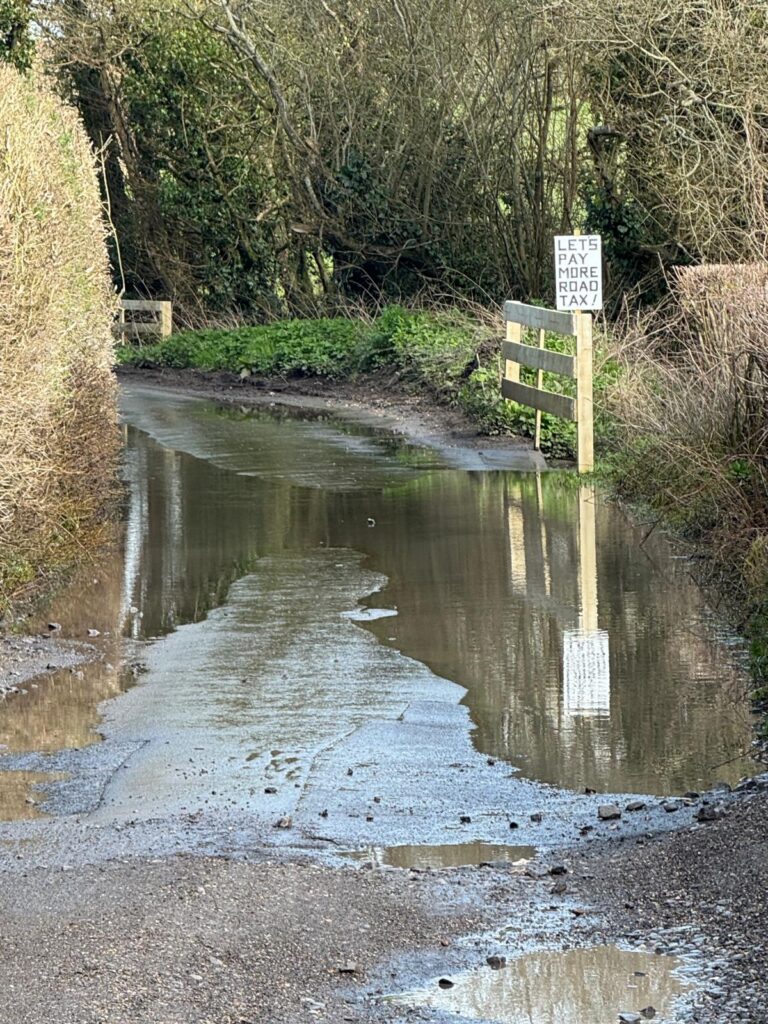
But the sign-maker, however justly aggrieved, is aiming at a ghost. There is no “road tax” in this country. There hasn’t been since 1937, when Churchill quietly redirected the Road Fund into general Treasury revenue. What we have is Vehicle Excise Duty, a tax on vehicle ownership, levied by CO₂ emissions band, that flows into the Consolidated Fund and has absolutely no hypothecated link to road maintenance. Not a penny of your VED is earmarked for our village road. Not a penny of it is earmarked for any lane, anywhere.
The roads beneath your wheels are funded through a different, grimmer arithmetic. East Sussex County Council spends roughly £13 million a year on reactive pothole repairs, gritting, and weed control, drawn from its general revenue budget, which means council tax. On top of this, the Department for Transport allocated £21 million to East Sussex for 2025/26 in capital grants for planned maintenance: resurfacing, patching, surface dressing, bridges. Looking ahead, the council has secured £106 million over four years from 2026/27. These sound like large numbers until you learn that ESCC itself estimates it would cost £10–15 million just to repair every pothole that currently falls below their intervention threshold, roughly four times what they actually spend on reactive repairs. And that’s before you get to the 5,000 roads in the county, the estimated £400 million total repair bill, and the fact that East Sussex now ranks second in England for pothole compensation payouts: nearly £600,000 between 2022 and 2024.
So the residents of our village are paying. They are paying through council tax, through VED, through income tax that flows to DfT grants, and through the suspension damage on their cars. What they are not getting is a road.
The Technology Exists. The Institutions Don’t.
Here is what makes this sign something more than a local grievance. The technology to manage road maintenance intelligently, to find potholes before they swallow a wheel, to predict which roads will fail next winter, to allocate scarce repair budgets where they deliver the greatest return, already exists. It is mature. It is proven. And almost nobody in English local government is using it properly.
Start with detection: Computer vision systems mounted on survey vehicles can now identify and classify road surface defects at speed, logging GPS coordinates, severity, and defect type. Companies like Vaisala and Gaist Solutions have been doing this at scale for UK local authorities for years. The more interesting recent development is crowdsourced sensing: the accelerometers in ordinary smartphones, mounted in ordinary cars, can detect surface anomalies passively. Uber patented a version of this years ago. Several startups have built on the concept. In principle, every vehicle with a phone mount is a roving pothole sensor, generating continuous condition data for free.
Then there is prediction and prioritisation – where the real value lies and where adoption is weakest. The problem in East Sussex is not that nobody knows where the potholes are. ESCC knows. FixMyStreet knows. The residents of our villages and towns most certainly know. The problem is deciding which defects to fix, in what order, with money that will never be sufficient. This is a classic optimisation problem: feed in road condition data, traffic volumes, weather forecasts, historical deterioration curves, utility works records, drainage maps, and complaint patterns, and you can model which stretches of road are most likely to fail next and where a pound spent on prevention saves five on emergency repair. Predictive asset management rather than reactive hole-filling. The tools exist – Gaist, Yotta (now Causeway), Jacobs’ modelling suites – but uptake is patchy because it requires good baseline data and a willingness to shift from complaint-driven to evidence-driven budgeting. Two things councils find culturally difficult.
Automated citizen engagement is the low-hanging fruit. FixMyStreet works, but it is essentially a digital complaints box. An AI triage layer could deduplicate reports, cross-reference with planned works, auto-classify severity from a submitted photo, and – critically – close the feedback loop by telling the reporter what is happening and when. That last step matters. People make signs because they feel ignored. A system that acknowledges, classifies, and updates is cheaper than a system that waits for frustration to become protest.
And then there is the frontier: autonomous repair. Robotiz3d, a Liverpool-based firm, has developed robotic units that can identify, clean, fill, and compact a pothole repair without a human crew. The economics are transformative for places like small English villages. A full highways crew will never be deployed to a single-track rural lane for a handful of potholes. An autonomous unit operating overnight on low-priority rural roads changes the cost calculus entirely.
The Real Pothole Is Institutional
I spend my professional life working with institutions that have the information they need and fail to act on it. The pattern is identical whether you are looking at crisis response systems in Whitehall, political economy analysis in Dhaka, or road maintenance in Lewes. The data exists. The analytical tools exist. The technology is available and, increasingly, affordable. What does not exist is the commissioning architecture to connect them.
England has 153 separate local highway authorities, each running its own procurement frameworks, its own inspection regimes, its own data standards, or lack of them.
The contrast with what’s happening elsewhere is instructive, if depressing and familiar.
France manages its national road network through CEREMA using standardised condition assessment and predictive modelling at national scale. Japan’s MLIT mandates uniform five-yearly close inspections of every bridge and tunnel in the country and is deploying AI crack analysis and drone-based monitoring across the national highway network through a single coordinated programme. South Korea has operated a centralised Pavement Management System since the late 1980s, run through the Korea Institute of Construction Technology, surveying 38,000 lane-kilometres of national road annually and now integrating AI-based crack analysis to replace manual assessment. Even a single American city (Chicago) built a predictive system that analyses 311 service requests to identify pothole hotspots before crews are dispatched. We have angry parishioners in Sussex staring at a flooded lane and an ironic sign.
The pattern and the dysfunction that underpins it will be familiar to anyone who has watched Whitehall try to modernise anything. The NHS spent over a decade and nearly £13 billion on the National Programme for IT before abandoning it. Universal Credit’s digital architecture was repeatedly redesigned mid-build. The MOD’s procurement cycles routinely deliver equipment a generation behind the threat. The common thread is not a lack of technology or even a lack of money – it is an institutional culture that treats proven digital tools as novelties to be piloted rather than infrastructure to be deployed. Our roads suffer from precisely the same pathology: the technology is available, the evidence base is strong, and the default response is to carry on doing what we have always done, even when the evidence for change is – quite literally – under your wheels.
Central government announces headline funding. Councils publish pothole counts to satisfy DfT reporting requirements. And the actual intelligence about where money should go sits trapped in spreadsheets and engineering judgment calls, unconnected to the sensor data, the weather models, or the deterioration curves that could make it useful.
From Potholes to Platforms
There is, buried in all of this, a product opportunity – and I will declare my interest. The gap is not in detection, which is increasingly commoditised, or in physical repair, which remains a matter of tarmac and labour. The gap is in the intelligence layer: the platform that ingests multiple data streams, models deterioration, and outputs optimised maintenance programmes for authorities that cannot build their own analytical capability. That is not a million miles from what we do at MetricsLed™ with ML-PROJECT, taking complex delivery environments, making the data legible, and turning it into decisions. The logic of SaaS-based project management applied to highway assets rather than cross Whitehall coordination or aid programmes.
But the deeper point is not commercial. It is about a country that has become remarkably skilled at measuring its own decline and remarkably resistant to doing anything differently about it. We know the roads are broken. We know why. We know what works. We have the technology, the data, and following the latest DfT settlement – a not-insignificant amount of money. What we lack is the institutional willingness to connect these things together.
Meanwhile, the sign stands in the floodwater, reflected perfectly: “LET’S PAY MORE ROAD TAX!” It’s sort of funny. It’s well-aimed. And it is, in its own way, a precise diagnosis of the problem, not because we need to pay more, but because even the people paying have no idea where the money goes, and the people spending it have no modern tools to spend it well.